How to play backgammon
Backgammon is a game for two players, each with fifteen checkers, played on a board with two dice. In Israel it is called shesh besh. Each player brings their checkers around the board to their own home board and then takes them off, and the first to take off all fifteen wins. The dice decide how far you move; you decide which checkers to move, when to take a risk and when to block your opponent's way.
This page explains the rules the app plays by, from the first roll to the end of a match. Read it through before your first game, or come back to one section when a question comes up.
The board and the starting position
The board has 24 long, narrow triangles called points, in four quarters of six points each. The bar, a strip down the middle of the board, divides it into two halves. Checkers that are hit wait on the bar, as explained below.
Each player numbers the points from their own side, from 1 to 24, and moves their checkers from their 24-point toward their 1-point. Your points 1 to 6 are your home board, the last quarter on the way. Your points 19 to 24 are your opponent's home board, where your way begins. The two players move in opposite directions, so your 24-point is your opponent's 1-point, your 13-point is their 12-point, and so on.
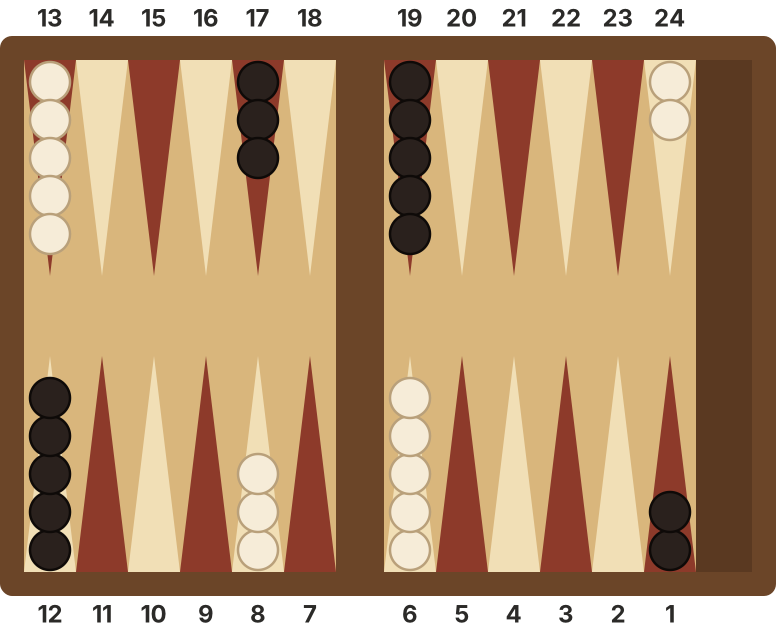
At the start of every game, each player's checkers stand in the same places, counted from that player's own side:
- two on the 24-point;
- five on the 13-point;
- three on the 8-point;
- five on the 6-point.
The two sets mirror each other across the board. In the app the players are White and Black, after the colour of their checkers.
The opening roll
Every game begins with the opening roll: each player rolls one die. The player with the higher number goes first, and plays the two numbers just rolled, their own and their opponent's, as their first roll. If both dice show the same number, they are rolled again, as often as it takes.
From then on the players take turns. Each turn starts with the player on turn rolling both dice.
In the app, one tap on Roll rolls a die for each player, and a tie is rolled again by itself.
Moving and doubles
The two numbers of a roll are two separate moves. Each one moves a checker forward, toward your 1-point, by exactly that many points. You can move one checker by one number and another checker by the other, or move the same checker by both, one number after the other.
A checker may land on an empty point, on a point that holds your own checkers, or on a point with a single checker of your opponent's, which it then hits (see the next section). It may never land on a point held by two or more of your opponent's checkers: that point is blocked. In the same way, two or more of your own checkers on a point keep your opponent off it.
When one checker plays both numbers, the point where it stops between them must be open too. With a roll of 5 and 3, for example, you may move one checker 5 points and another 3, or move one checker 8 points, as long as it can stop on the way after the 5 or after the 3.
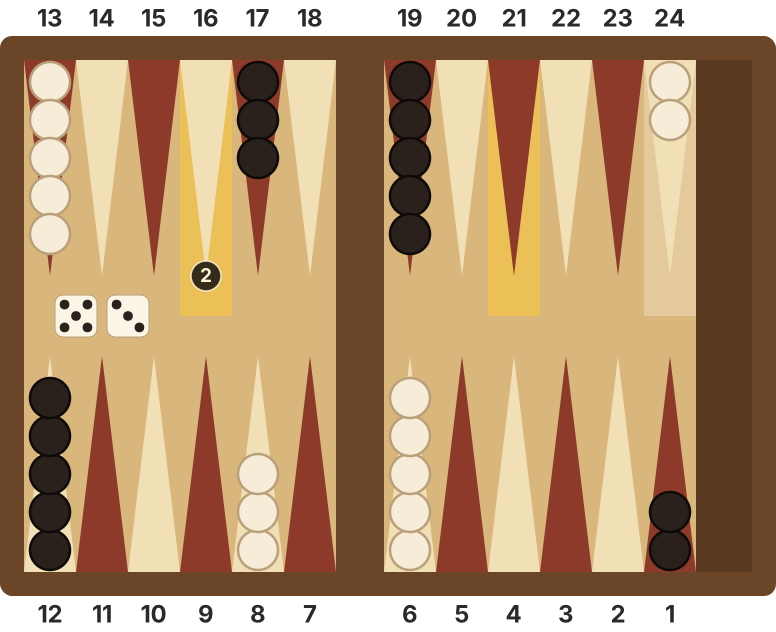
A roll with the same number on both dice is a double, and it is played twice over: 4 and 4 gives four moves of 4 points, made with one checker or shared among several.
In the app, a tap on a checker lights up the points it can reach, and only moves the rules allow can be made. Until you tap End turn, Undo takes your moves back.
Hitting a blot and entering from the bar
A checker standing alone on a point is a blot. When your checker lands on your opponent's blot, it hits it: the hit checker leaves its point and goes to the bar. A point with two or more checkers cannot be hit.
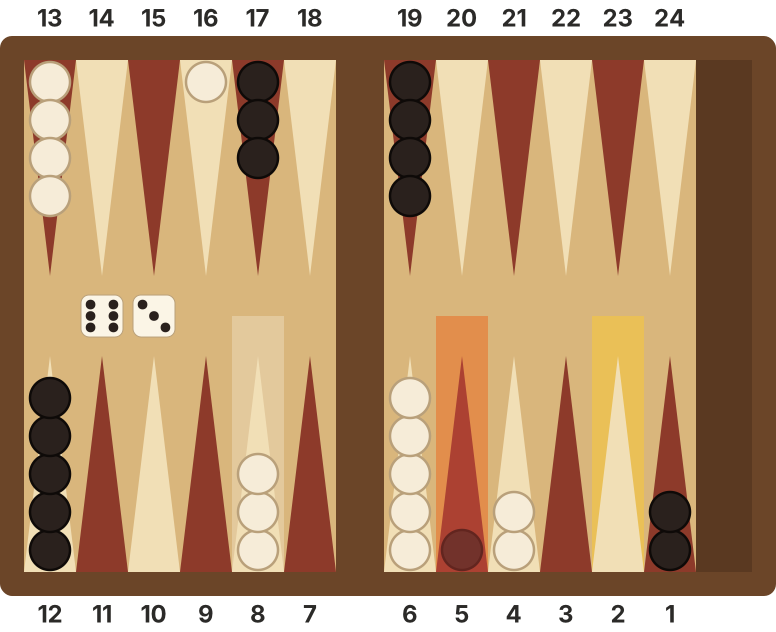
If you have a checker on the bar, you must bring it back into play before moving any other checker. It enters in your opponent's home board, where every checker's way begins: a 1 enters on your 24-point, a 2 on your 23-point, and so on, up to a 6 on your 19-point. It can enter only on a point that is not blocked, and if it enters on a blot of your opponent's, that blot is hit in turn.
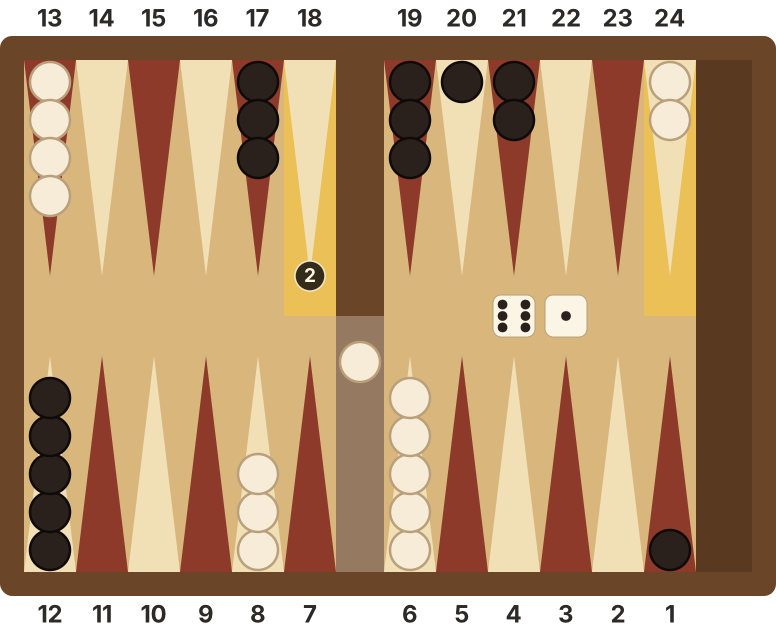
If neither number lets your checker enter, you cannot move at all, and the turn passes to your opponent. With two checkers on the bar, both must enter before any other checker moves; if only one of them can, the other number is lost. Once all your checkers have entered, any number left over is played as usual, by the checker that entered or by any other.
When your opponent holds all six points of their home board, a closed board, a checker on the bar cannot enter at all, and each of your rolls passes without a move until a point opens.
In the app, when a roll allows no move at all, a short message says so, and the turn passes by itself.
When you must use both dice, or the higher one
You must use as much of your roll as you can. If there is any way to play both numbers, you must play both, even when that means a move you would rather not make, and you may not choose a first move that leaves the second number with nowhere to go.
If only one of the two numbers can be played, you must play it. If either number could be played on its own but not both of them, you must play the higher one. With a double, you play as many of the four moves as you can.
A number that cannot be played is lost, and the turn ends. The app keeps these rules for you: it offers only the moves that follow them.
Bearing off
Once all fifteen of your checkers are in your home board, you may start bearing them off, that is, taking them off the board. A checker on the bar, or anywhere outside your home board, stops you from bearing off until it is home.
A number bears off a checker from the point of the same number: a 4 bears off a checker from your 4-point. A number higher than your highest occupied point bears off a checker from that highest point: with checkers only on your 3-point and below, a 6 bears off from the 3-point. But when the point of the number rolled is empty and you have checkers on higher points, that number cannot bear off, and can only move a checker inside your home board.
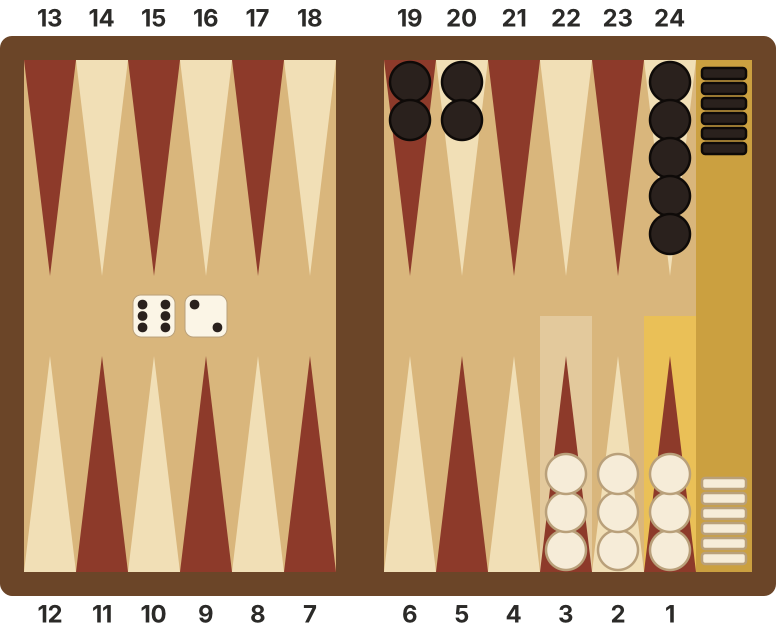
Bearing off is not your only choice: you may also move checkers inside your home board, as long as you use your roll as fully as you can (see the section before). Sometimes that rule makes a move inside come first, so that both numbers can be played.
If one of your checkers is hit while you are bearing off, it must enter from the bar and come all the way back to your home board before you may bear off again.
The first player to bear off all fifteen checkers wins the game at once. Any number left over from that roll is not played.
A plain win, a gammon and a backgammon
A game is worth 1, 2 or 3 points, depending on how far the loser got:
- a plain win, worth 1 point, when the loser has borne off at least one checker;
- a gammon, worth 2 points, when the loser has not borne off a single checker;
- a backgammon, worth 3 points, when the loser has not borne off a single checker and still has one on the bar or in the winner's home board.
One checker borne off is enough to save the loser from a gammon, even with others still on the bar.
Matches
A match is a series of games between the same two players. Before it starts, you choose the match length: 1, 3, 5 or 7 points. Each game adds its 1, 2 or 3 points to the winner's score, and the first player to reach the match length wins the match. A gammon or a backgammon counts in full, even when it takes the winner past the match length. A match of 1 point is a single game.
Every game of a match starts again from the starting position, with a new opening roll to decide who goes first. When the match is over, Rematch starts a new match between the same two players, with the same colours and the same length.
No doubling cube
Tournament backgammon adds a doubling cube, a large die whose faces read 2, 4, 8, 16, 32 and 64, with which a player may offer during a game to double what it is worth. The app plays without it, as shesh besh is usually played in Israel. A game is always worth 1, 2 or 3 points, and the match rules that exist only because of the cube, such as the Crawford rule, do not apply.
Ready to play?
That is all you need for a first game. The app knows every rule on this page, so you can learn as you play.